English
  日本語
日本語  한국어
한국어  français
  Deutsch
  Español
  italiano
  русский
  português
  العربية
  Ελλάδα
Titanium fasteners are widely preferred in demanding industries because they offer an excellent balance of lightweight performance, high strength, corrosion resistance, and long-term reliability. Compared with traditional steel fasteners, titanium solutions help engineers reduce overall system weight while maintaining structural integrity, making them suitable for aerospace, automotive, racing, marine and industrial applications.
In high-performance applications, fasteners are more than connection components. Their material properties directly influence safety, durability, and maintenance requirements. Selecting the right fastening material can improve product performance and extend service life, especially in environments involving vibration, extreme temperatures, or corrosive conditions.
The main reason titanium fasteners are used in advanced applications is their superior strength-to-weight ratio. Titanium provides comparable mechanical performance to many steel alloys while offering significantly lower density.
This weight advantage matters most in industries where reducing unnecessary mass directly improves efficiency. Aerospace manufacturers, racing teams, and high-performance equipment producers often choose titanium components because even small weight reductions can contribute to better overall performance.
Another important advantage is corrosion resistance. Titanium naturally develops a stable oxide layer that protects the material from many corrosive environments, including seawater, moisture, and chemical exposure. This reduces the need for additional protective coatings and helps maintain reliable performance over long operating periods.
Titanium and steel are both widely used fastening materials, but they serve different application requirements.
Steel fasteners are commonly selected for general industrial applications because of their availability and cost efficiency. However, titanium provides several advantages when performance requirements become more demanding:
Lower weight compared with steel
Excellent corrosion resistance
High fatigue resistance
Strong performance in harsh environments
Reduced maintenance requirements
For industries where weight reduction and durability are critical, titanium fasteners provide a practical solution for improving component efficiency and reliability.
Titanium fasteners are used across industries where material performance is a key consideration.
The aerospace industry is one of the largest users of titanium components. Aircraft structures require materials that can withstand vibration, temperature changes, and long service periods while keeping weight as low as possible.
Titanium fasteners help aerospace manufacturers achieve weight reduction without compromising safety and mechanical performance. Their corrosion resistance also makes them suitable for aircraft environments where long-term reliability is essential.
In automotive engineering, reducing vehicle weight can improve acceleration, handling and energy efficiency. Motorsport applications especially demand lightweight components that can maintain strength under extreme conditions.
Components such as titanium bolts are commonly selected in racing applications because they provide weight advantages while maintaining excellent mechanical properties.
Marine environments create significant corrosion challenges because components are constantly exposed to saltwater and moisture.
Titanium’s natural corrosion resistance makes it suitable for marine equipment, offshore structures, and other applications where long service life is required.
Many industrial projects require fasteners with specific dimensions, thread designs, or performance requirements. Standard products may not always meet these specialized needs.
Manufacturers can provide custom titanium fasteners based on engineering drawings, application requirements, and production specifications to support specialized industrial projects.
Different titanium grades provide different performance characteristics. Selecting the appropriate grade depends on strength requirements, environmental conditions, and application purpose.
| Titanium Grade | Density | Tensile Strength | Key Characteristics | Common Applications |
|---|---|---|---|---|
| Grade 2 Titanium | Approx. 4.5 g/cm³ | Approx. 345 MPa | Excellent corrosion resistance and good formability | Marine, chemical equipment |
| Grade 5 Titanium (Ti-6Al-4V) | Approx. 4.43 g/cm³ | Approx. 895 MPa | High strength-to-weight ratio and excellent fatigue resistance | Aerospace, racing, industrial applications |
Ti-6Al-4V Grade 5 titanium is one of the most commonly selected titanium alloys for high-performance fasteners because it provides an excellent combination of strength, lightweight properties, and corrosion resistance.
Manufacturing titanium components requires specialized knowledge because titanium behaves differently from conventional metals during machining.
Important manufacturing considerations include:
Precision CNC machining
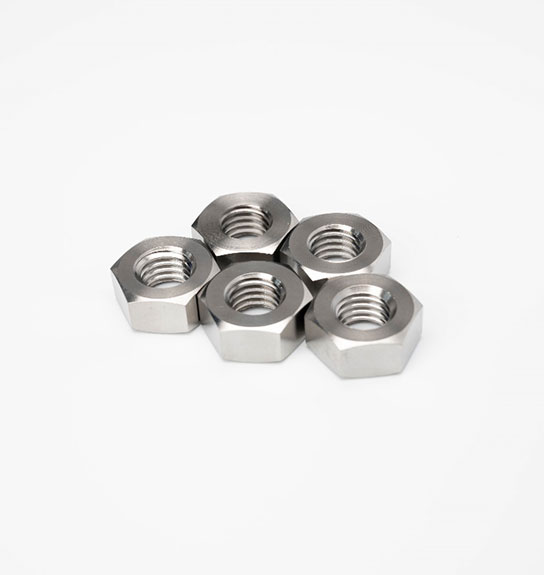
Accurate thread processing
Proper cutting parameters
Surface finishing control
Material traceability
Quality inspection
Titanium has lower thermal conductivity than many metals, which means heat management during machining is critical. Professional manufacturers use optimized processes to maintain dimensional accuracy and consistent product quality.
For applications requiring specialized fastening solutions, products such as titanium self-tapping bolts can be manufactured according to specific design requirements and industrial applications.
Choosing a titanium fastener supplier requires evaluating manufacturing capability, quality management, and technical experience.
Important factors include:
Reliable suppliers should provide material documentation to confirm titanium grade, chemical composition, and product traceability.
Precision machining capability is essential because titanium fasteners require strict control of dimensions, threads, and surface quality.
Different industries often require unique specifications. A supplier with customization experience can provide solutions based on engineering drawings and application conditions.
Consistent inspection procedures help ensure that fasteners meet required mechanical and dimensional standards.
Working with an experienced manufacturer helps companies achieve stable supply, consistent quality and optimized fastening solutions.
Titanium fasteners have become an important choice for aerospace, automotive, marine and industrial applications because they provide lightweight performance, corrosion resistance and long-term reliability. Their ability to maintain strength while reducing weight makes them especially valuable in industries where efficiency and durability are critical.
As engineering requirements continue to advance, selecting the right titanium material and manufacturing partner will remain an important factor in achieving reliable product performance.
Titanium fasteners are not always stronger than every type of steel fastener, but they provide a better strength-to-weight ratio. This makes them highly valuable in applications where reducing weight while maintaining performance is important.
Titanium fasteners require specialized raw materials and machining processes. The manufacturing difficulty and material cost are higher than standard steel fasteners, but the benefits of lightweight performance and corrosion resistance often justify the investment.
Yes. Titanium has excellent resistance to seawater corrosion, making it suitable for marine equipment, offshore applications and other harsh environments.
Aerospace, motorsport, automotive, marine, and advanced industrial manufacturing industries commonly use titanium fasteners because these sectors require high-performance materials.
Yes. Titanium fasteners can be produced according to specific dimensions, thread designs, material grades and application requirements.
Popular Products
 +86-917-3309953
 NO.59 JUFU ROAD, WEIBIN DISTRICT, BAOJI CITY, SHAANXI PROVINCE